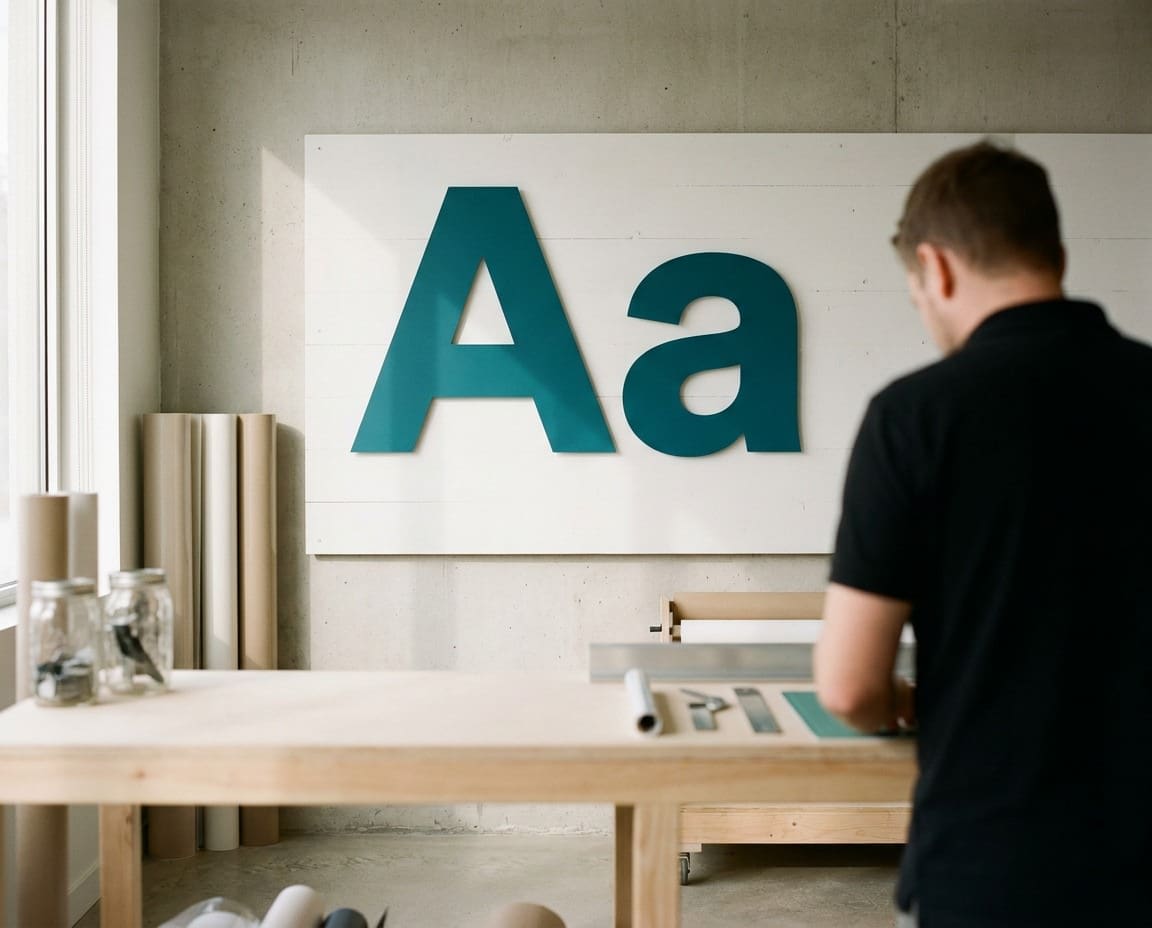
A lot of customers assume a sign needs big capital letters to have impact. It feels logical: capitals look bold, important and loud. But when it comes to capitals or lower case, the evidence from decades of sign making points the other way. For most wording, mixed case is easier to read, especially at a distance and at speed.
This guide explains why, tells the story of the most famous sign lettering in Britain, and shows when capitals still earn their place on shop signs and exterior signs.
Why all capitals feels like shouting
We have all had an email written entirely in capitals, and we all read it the same way: as shouting. A sign is no different. A long line of capitals feels aggressive, and it is harder work for the reader.
That matters on a shopfront. You want people to feel welcome, not barked at. A friendly café, a florist or a dental practice set in heavy capitals sends the wrong message before a single word has been read.
Why mixed case is easier to read
The usual explanation is word shapes. Lower case letters vary in height. Some rise above the line, like b, d, h, k and l. Some drop below it, like g, j, p and y. Together they give each word a varied outline, so the eye has more clues to recognise it quickly.
Capitals are all the same height. Set a word in capitals and it becomes a neat rectangle, much like every other word around it. The reader has to work through the letters rather than take in the word at a glance.
| All capitals | Mixed case | |
|---|---|---|
| Word outline | Flat rectangle | Varied, distinctive shape |
| Width | Wider for the same letter height | Narrower, so letters can be bigger |
| Tone | Formal, urgent, loud | Friendly, natural, calm |
| Best for | One or two short words | Names, phrases and longer lines |
The hidden cost of capitals: space
There is a practical point too. Capitals take up more width than lower case at the same height. On a fascia of fixed size, setting the same words in capitals means making every letter smaller to fit. So the capitals you chose for impact can end up less visible than mixed case would have been.
What UK road signs teach us about capitals or lower case
The best real world test of lettering in Britain is on our roads, and it settled the capitals or lower case question decades ago.
Before the motorways
For years, British road signs used a capitals only alphabet known as Llewellyn-Smith, introduced after the Maybury Report of 1933. On slower roads that was workable. Then Britain began building motorways, and drivers needed to read place names at high speed.
The Anderson Committee and the Preston Bypass
In 1957 the Ministry of Transport set up an advisory committee on motorway signs, chaired by Sir Colin Anderson. The designer Jock Kinneir was appointed, with Margaret Calvert, then his young assistant, working alongside him. They looked at signs across Europe and the United States and were not impressed.
Kinneir and Calvert concluded that a mix of upper and lower case letters was more legible than all capitals, and they designed a new typeface for the job. It was later named Transport. Their signs first appeared in 1958 on the Preston Bypass, now part of the M6, and went on to the M1.
The Worboys Committee and every road in Britain
The success on the motorways led to a second committee, chaired by Sir Walter Worboys, to look at signs on all other roads. Kinneir and Calvert designed again. The Worboys report, published in 1963, recommended mixed case lettering, and the new system became law on 1 January 1965.
Transport is still the lettering on British road signs today. It comes in two weights: Transport Medium for white lettering on dark backgrounds, like green primary route signs, and Transport Heavy for dark lettering on white. Next time you are on a motorway, notice how quickly you take in the place names. That is mixed case doing its job.
When capitals do work
None of this means capitals are banned. Phil’s view is simple: use them sparingly, and for a reason. Capitals work well in a handful of situations.
- Short words: one or two words like OPEN, EXIT or SALE read instantly in capitals.
- Logos and wordmarks: if your logo is set in capitals, keep it that way. It is a picture of your name, read as a shape.
- Headings and labels: a short heading in capitals above mixed case text gives structure without shouting.
- Warnings: DANGER and STOP are meant to feel urgent.
- Engraved and traditional plaques: carved or etched capitals suit a formal nameplate with very few words.
How to use capitals well on a sign
If capitals are the right choice for part of your sign, a few rules make the difference between smart and clumsy.
- Keep lines short. Capitals for two or three words, mixed case for anything longer.
- Add a little extra spacing. Capitals set tightly crowd each other. Open the letter spacing slightly so each one stands clear.
- Check the awkward pairs. Combinations like AV, LT and WA leave odd gaps. Our article on kerning explains how those gaps are corrected.
- Choose the right typeface. Some fonts have capitals that are elegant on their own, others need lower case to look right. Our guide on which font to choose covers this.
- Do not mix at random. Decide which elements are capitals and which are mixed case, and apply it the same way everywhere.
Test it before you commit
Phil’s advice is the same as for every design decision. Set your wording both ways, put it on screen, and stand back from the monitor, as far as the room allows. Which one can you read faster? Which one feels like your business?
Then get a second opinion, ideally from someone who has never seen the design. Ask them to read it aloud from across the room. Their first reaction is worth more than an hour of staring at the screen yourself.
Planning lettering for a new sign?
We can help you get the balance of capitals and lower case right, so your sign reads clearly and feels like you. Browse our shop signs and exterior signs, or call us on 01296 399202 to talk it through.
Leave a Reply Cancel reply
Put your brand on everything.
Your brand doesn't stop at the screen. Sign Rite Grafix puts it on your vehicle, your windows, your walls, your pop-up, wherever it needs to be seen. If you can picture it, they can make it and fit it.
FROM THE DIGITAL WORLD TO THE REAL ONE



comment on this post