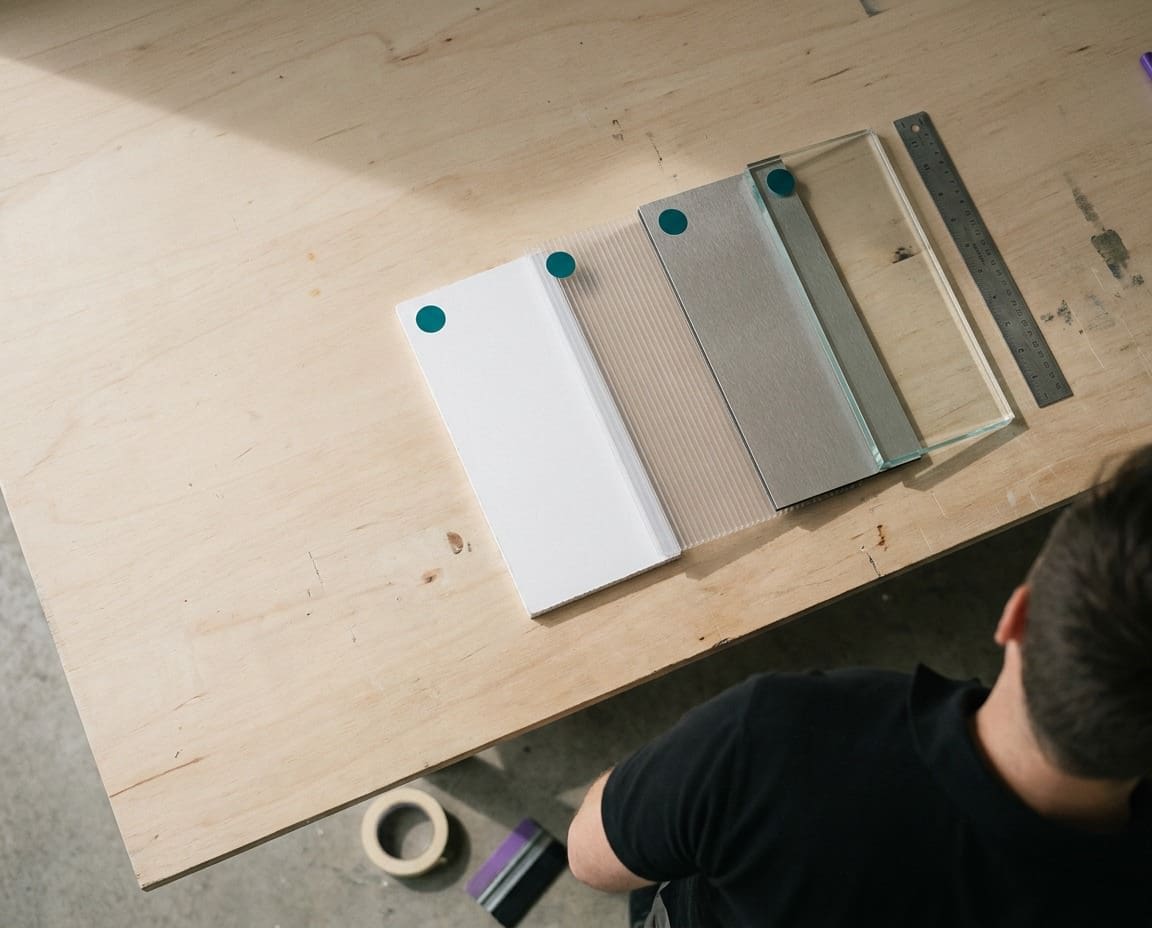
Order a printed sign and the first question back is usually: what board would you like it on? Foamex, Correx, Dibond and acrylic are the four names you hear most, and if they mean nothing to you, you are in good company. Choosing the right sign board comes down to three things: where the sign is going, how long it needs to last and how it will be fixed.
Pick well and the sign looks right for its whole life. Pick badly, however, and you either pay for durability you did not need or replace a sign that gave up too soon. Here is a plain guide to each board, with a comparison table and our picks for common jobs. You can see the full range on our print and display page.
The four sign boards explained
Correx: light, cheap and short term
Correx is the name most people use for fluted polypropylene sheet. It is a registered trademark, but the word has become shorthand for any twin-wall plastic board, the kind you see on estate agents’ boards and roadside event signs. Look at the edge and you will see the channels, or flutes, running through it.
- Common thickness: 4mm is the everyday choice for signs, with thinner and thicker sheets available
- Strengths: very light, waterproof and inexpensive
- Weaknesses: flexes in the wind, shows its flutes at the edges and dents more easily than a solid board
- Life: made for temporary use outdoors, from a few weeks to a season
As a result, Correx is ideal for anything short term or on the move: estate agents’ boards, event directions, site safety notices and election-style placards. It fixes easily with cable ties through the flutes, or slides onto metal stakes.
Foamex: smooth, rigid and made for indoors
Foamex is the name the sign trade uses for PVC foam board. It is a solid sheet with a lightweight foamed core and a smooth, flat surface that takes print beautifully. It cuts cleanly, so shaped signs and cut-out letters are easy.
- Common thicknesses: 3mm, 5mm and 10mm
- Strengths: clean finish, light, easy to cut into shapes
- Weaknesses: thinner sheets bend, and outdoors it can deteriorate and warp in heat and strong sun
- Life: years indoors, much shorter outside
Thickness also matters. 3mm suits posters and point of sale that sit in a frame or against a wall. 5mm gives a sturdier indoor sign. 10mm is the one to choose if Foamex has to stand up to the weather for a while.
Dibond: aluminium composite for the long haul
Dibond is a brand of aluminium composite material, often called ACM. It is made of two thin aluminium sheets bonded to a plastic core, which gives you a panel that is light, very flat and properly rigid. It does not rust, it shrugs off rain and it keeps its shape for years.
- Common thicknesses: 2mm, 3mm and 4mm, with 3mm the everyday choice for signs
- Strengths: flat, rigid, weatherproof and smart looking
- Weaknesses: costs more than plastic boards and is heavier than Correx or Foamex
- Life: years outdoors
Dibond is the board we reach for when a sign has to stay up and look good: fascia panels, building signs, car park and site signs, wall-mounted plaques and outdoor menu boards. It can be screwed, riveted or bonded to almost any surface, and it can be folded into tray signs with returned edges for a cleaner, more solid look.
Acrylic: the premium finish
Acrylic is a clear or coloured plastic sheet with a glossy, glass-like face. You will know it by the brand name Perspex. It is the board for signs where first impressions count.
- Strengths: glossy, premium finish with real depth
- Weaknesses: scratches more easily than metal and costs more than the plastic boards
- Life: years, and best suited to indoor use
The classic acrylic sign is printed on the back, so the print sits behind a polished face, and mounted on stand-off fixings so it floats off the wall. Acrylic can also be cut into shapes and individual letters, and its edges can be polished for a clean, finished look. Reception signs, door signs and office branding are where it shines.
Printing, edges and fixings
Boards are printed in two ways. Some are printed directly on a flatbed printer. Others instead have a printed vinyl applied to the face, often with a protective laminate on top. We print wide format on our HP Latex printer, which gives rich colour on vinyl for mounting onto board.
The edge tells you a lot about a finished sign:
- Correx shows its flutes, which is fine for a temporary sign
- Foamex cuts to a clean, solid edge
- Dibond shows a thin line of core between the aluminium skins, or none at all if folded into a tray
- Acrylic can be polished to a clear, glassy edge
Finally, fixings follow the board. Correx suits cable ties and stakes. Foamex works with screws, sticky pads or a frame indoors. Dibond takes screws, rivets, bonding and rail systems. Acrylic, meanwhile, looks best on stand-offs.
Foamex, Correx, Dibond or acrylic at a glance
| Board | What it is | Common thickness | Best place | Typical life |
|---|---|---|---|---|
| Correx | Fluted polypropylene | 4mm | Outdoor, temporary | Weeks to a season |
| Foamex | PVC foam board | 3mm, 5mm, 10mm | Indoor | Years indoors |
| Dibond | Aluminium composite | 3mm | Outdoor, long term | Years |
| Acrylic | Glossy plastic sheet | Various | Indoor, premium | Years |
Which board for which job?
Here are our picks for the signs we are asked about most:
- Estate agent board: Correx. Light, cheap and easy to put up and take down.
- Indoor menu board: Foamex, or acrylic for a premium counter.
- Outdoor menu board or A-board insert: Dibond, which handles rain and knocks.
- Fascia panel: Dibond, flat and weatherproof for years above the shop window.
- Reception sign: acrylic on stand-offs, back printed for depth.
- Site hoarding: Dibond for long builds, Correx for short works or quick notices.
- Pop-up shop graphics: Foamex inside the unit. Our pop-up shop checklist covers the rest of the plan.
If the sign is going on the outside of your building, read our guide to shop sign planning permission before you order.
Three questions before you choose
- Inside or outside? Long term outside points to Dibond. Short term outside points to Correx.
- How long does it need to last? Weeks, months or years changes the answer more than anything else.
- How will it be fixed? Stakes and cable ties, screws to a wall, a frame or stand-offs each suit different boards.
For very large or temporary signs, however, a PVC banner is often a better answer than any board. Mesh banners let the wind through, which makes them the right choice for fences and scaffolding.
Still not sure which board?
Tell us where the sign is going, how long it needs to last and the size you have in mind, and we will point you to the right board. See our banners, boards and printed signs page or our exterior signs page, or call us on 01296 399202.
Leave a Reply Cancel reply
Put your brand on everything.
Your brand doesn't stop at the screen. Sign Rite Grafix puts it on your vehicle, your windows, your walls, your pop-up, wherever it needs to be seen. If you can picture it, they can make it and fit it.
FROM THE DIGITAL WORLD TO THE REAL ONE

comment on this post