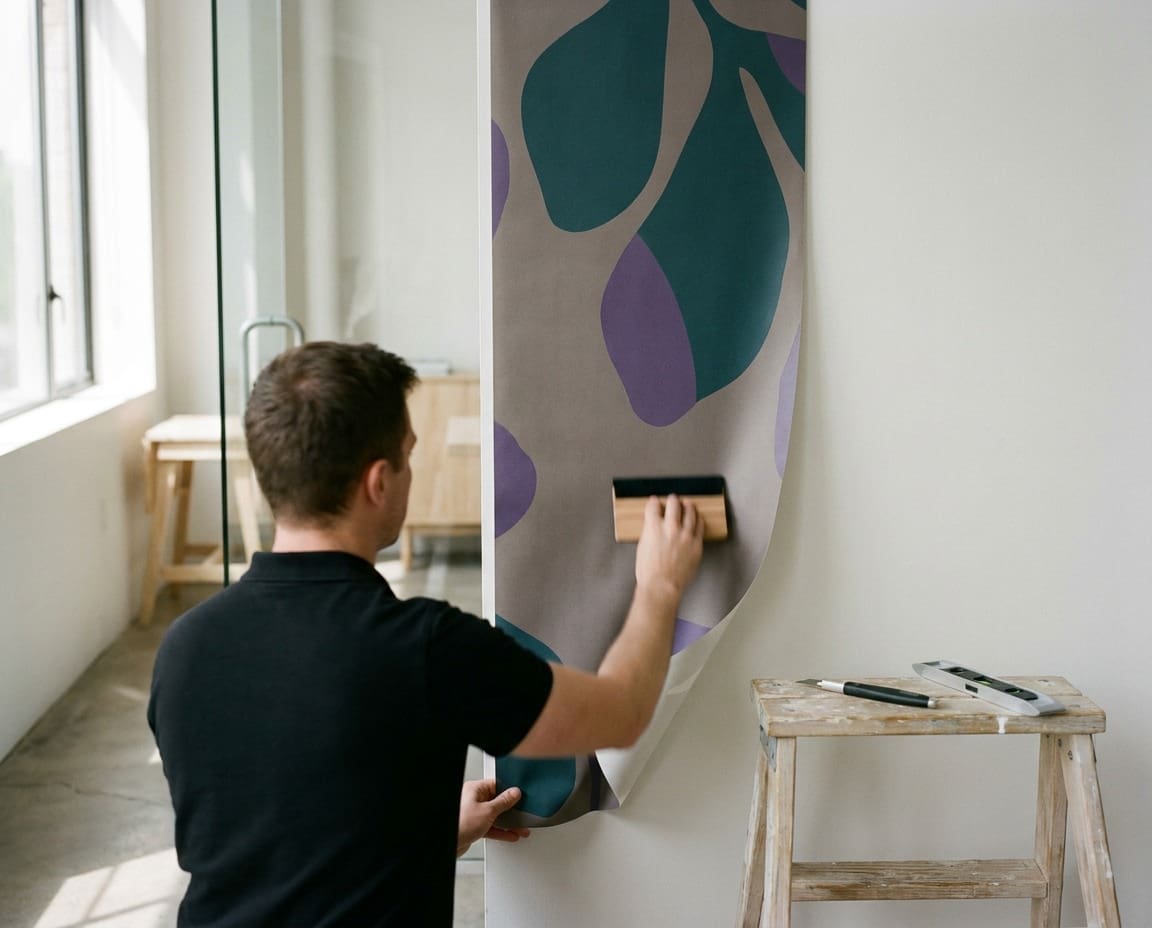
Self-adhesive wallpaper is sold as the easy option: no paste, no mess, peel it off when you fancy a change. Some of that is true. But the packaging leaves out a fair bit, and we hear from plenty of people who found out the hard way that peel-and-stick still takes skill, patience and the right wall.
We print and fit wall graphics and office murals and decorative films for businesses, so we see both sides. This is a fair guide to what self-adhesive wallpaper is good at, where it falls short, and how it compares with traditional wallpaper and professionally printed murals.
What self-adhesive wallpaper actually is
Self-adhesive wallpaper is a printed film or paper with an adhesive already on the back, protected by a backing sheet. You peel the backing away and press the paper onto the wall. There is no paste table, no bucket and no soaking time.
That is the appeal, and for a small area such as the back of a bookcase or a cupboard door it works well. Once you move to a full wall, the job looks much more like proper wallpapering than the shop display suggests.
The parts the packaging skips
You still need to measure, trim and hang straight
Peel-and-stick does not remove the basic skills of hanging wallpaper. You still measure the wall, work out drops, match the pattern, mark a plumb line and trim neatly at the ceiling, skirting and around sockets. If the first drop is crooked, every drop after it will be too.
Peel the backing a section at a time
Pull the whole backing off at once and the paper curls, sticks to itself and grabs the wall in the wrong place. The better method is to peel back a short section at the top, position it, smooth it down, then peel and smooth as you work downwards. It takes two hands, a smoothing tool and steady pressure.
It only suits smooth walls
The adhesive needs a smooth, sound, clean surface to grip. Textured plaster, woodchip, flaking paint or fresh plaster will all cause trouble. Bumps and dents show through thin film, so the wall prep matters as much as with any wallcovering.
Some paints stop it sticking
Wipeable and easy-clean paints are designed to resist stains and grease, and that same surface can stop self-adhesive paper bonding properly. Edges lift, corners peel and the paper creeps off the wall over a few weeks. It is one of the most common reasons peel-and-stick fails.
Temperature affects the adhesive
Adhesives are sensitive to temperature. In a cold room the glue is less tacky and struggles to bond, and in a hot, sunny spot it softens. Hang it in a room at a normal, comfortable temperature, and avoid walls that get very hot or very cold.
Removable does not always mean clean removal
This is the big one. When you peel the paper off, it can take paint with it, or leave sticky residue behind. Be ready to fill, sand and repaint the wall afterwards, which is exactly the work peel-and-stick promised to save you.
Your design is on thousands of other walls
Off-the-shelf designs are made in big runs. That palm print or geometric pattern is in thousands of homes and probably on a few café walls too. For a home that is fine. For a business that wants to look like itself, it is a missed opportunity.
Peel-and-stick vs traditional vs printed murals
Here is how the three main options compare.
| Self-adhesive wallpaper | Traditional wallpaper | Professionally printed mural | |
|---|---|---|---|
| Hanging | No paste, but still needs measuring and trimming | Paste the paper or the wall, more mess | Fitted by a professional, or supplied in panels to hang |
| Wall type | Smooth, sound walls only | Most sound walls with proper prep | Most sound walls with proper prep |
| Design choice | Limited to stock designs | Wide range of stock designs | Any image, photo or custom design, sized to your wall |
| Removal | Can lift paint or leave residue | Usually needs steaming or soaking | Depends on material chosen |
| Best for | Small areas and short-term updates | Whole rooms at home | Feature walls and branded spaces |
Wall prep for any wallcovering
Whichever option you choose, the wall decides how good the result will be. Before anything goes up, we check the following:
- The surface is smooth, with holes and cracks filled and sanded flush.
- The paint is fully cured, not freshly applied.
- The wall is clean, dry and free from dust and grease.
- There is no damp, flaking paint or loose plaster.
- You know what paint is on the wall, especially if it is a wipeable or easy-clean finish.
Skipping prep is the fastest way to waste good wallpaper. A few hours with filler and sandpaper saves a lot of frustration later.
The alternative: a bespoke printed wall mural
For a business, a printed wall mural is usually the better answer. Instead of choosing from a shelf of stock designs, you start with your wall measurements and build the design to fit them exactly.
We print murals in-house on our HP Latex printer, and there are several materials to choose from:
- Self-adhesive: sticks straight to a suitable smooth wall, ideal for flat, clean surfaces.
- Pre-pasted: the paste is already on the back and is activated with water.
- Paste-free: goes up without any mixing or brushing on of paste, so there is no paste table or bucket.
Finishes include satin, matt and textured, so you can choose a subtle look or something with more depth. The artwork can come from an image library, your own photograph or a custom design made for your brand, such as a city skyline, your product, or a pattern built from your logo.
When to call a professional
A small home project is a good place to try peel-and-stick yourself. A business feature wall is different, because it is on show to every customer and every member of staff, every day. Call in a professional when:
- It is an office feature wall in a reception, meeting room or breakout area, where your brand needs to look sharp.
- It is a café or restaurant wall that has to handle busy service and regular wiping down.
- It is a salon or clinic where the wall forms part of the customer experience and appears in photos.
- The wall is large or awkward, with windows, doors, sockets or corners to work around.
- You need a custom size or design that no stock wallpaper can match.
A professional will measure, check the wall, choose the right material and finish, and line up every panel so the design flows. It is the difference between a wall that looks like a DIY weekend and one that looks like it was always meant to be there.
Planning a feature wall?
If you are thinking about a feature wall for your office, café or salon, we can design, print and fit it for you. Take a look at our office wall graphics and murals or call our studio on 01296 399202.
Leave a Reply Cancel reply
Put your brand on everything.
Your brand doesn't stop at the screen. Sign Rite Grafix puts it on your vehicle, your windows, your walls, your pop-up, wherever it needs to be seen. If you can picture it, they can make it and fit it.
FROM THE DIGITAL WORLD TO THE REAL ONE


comment on this post