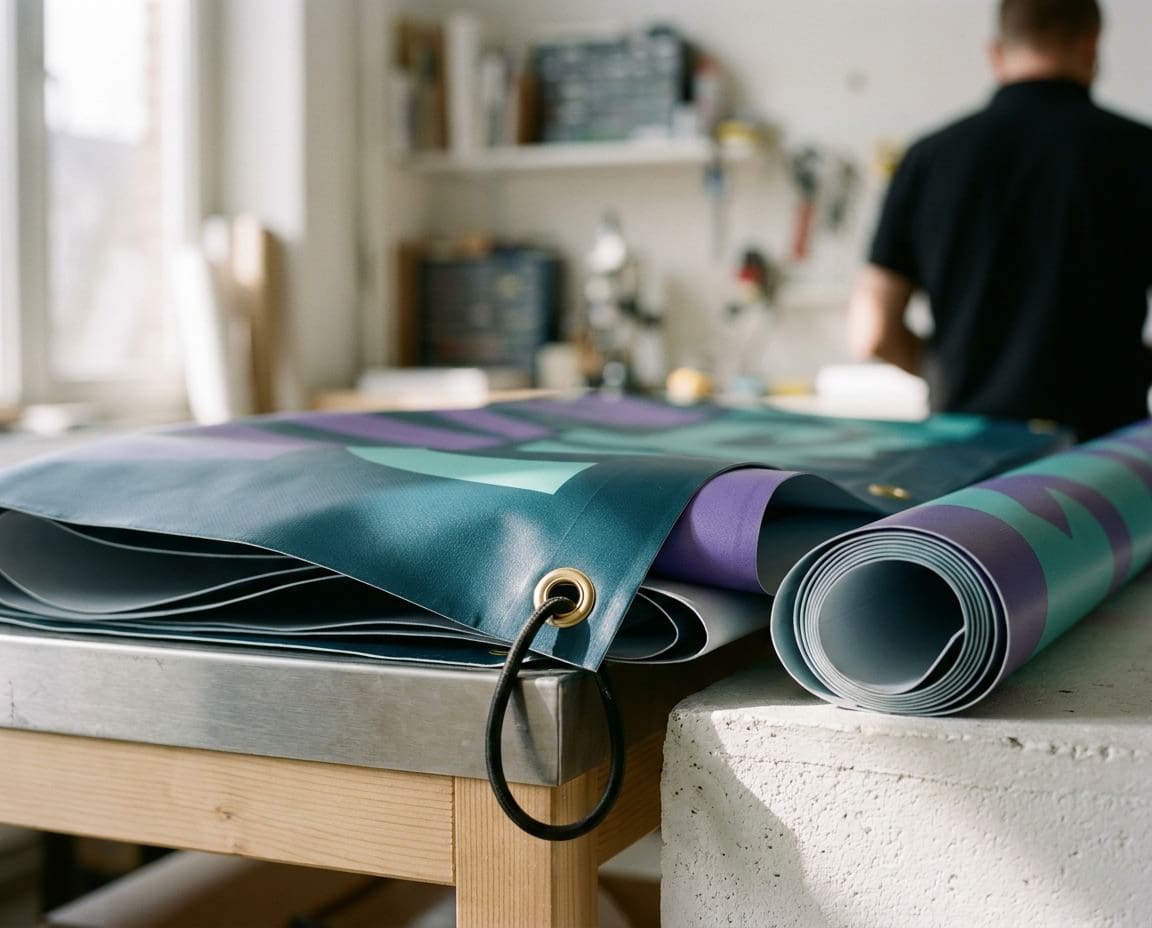
PVC banners are the workhorse of outdoor advertising. They go up on railings, fences, scaffolding and shop fronts, they are quick to put up, and they stand up to British weather. For an opening, an event, a sale or a building site, a printed PVC banner is often the simplest way to get noticed.
This guide covers what to decide before you order: size, material, finish, fixings and artwork. You can see the full range of banners and display products on our print and display page.
Common PVC banner sizes
Banners in the UK are still usually described in feet, but they are printed in millimetres. Here are the sizes we are asked for most, with their exact metric equivalents.
| Size in feet | Size in millimetres | Typical use |
|---|---|---|
| 3 x 2 ft | 914 x 610mm | Small notices, gates and doors |
| 6 x 2 ft | 1829 x 610mm | Railings, shop fronts, school fences |
| 8 x 3 ft | 2438 x 914mm | Events, open days, building sites |
| 10 x 3 ft | 3048 x 914mm | Long fences and roadside frontages |
| 8 x 4 ft | 2438 x 1219mm | Larger notices and site hoardings |
Banners can be made to almost any size, so these are starting points rather than limits. Measure the space where the banner will hang, including the fixing points, before deciding.
Getting the proportions right
A long, narrow banner suits a short message read from the side of a road. A squarer banner gives more room for a picture and detail, but it needs to be seen from closer up. Think about where people will be standing or driving when they read it.
PVC banner material weights
Banner material is described by weight in grams per square metre, or gsm. The heavier the material, the stronger and more durable it is.
- 440gsm PVC: the standard banner material. Strong, good to print on and right for most indoor and outdoor jobs.
- 510gsm PVC: a heavier material for banners that stay up outdoors for longer or face more exposure to weather.
- Mesh PVC: a perforated material, often around 380gsm, that lets air pass through.
Mesh vs solid banners in the wind
Wind is the main enemy of any banner. A solid PVC banner catches the wind like a sail, which puts strain on the eyelets, the fixings and whatever it is tied to. In exposed spots, a solid banner can tear or pull its fixings loose.
Mesh banners are full of tiny holes that let wind pass straight through. They are the right choice for scaffolding, high fences, open sites and anywhere the wind gets up. The print is slightly less solid up close, but from a distance it reads well.
For solid banners in breezy spots, some people cut small flaps into the banner to let air through. It helps a little, but it weakens the material and spoils the design. If wind is a real concern, mesh is the better answer.
Banner finishes
The finish is how the edges are made and how the banner is fixed. The right one depends on how and where it will hang.
Hems and eyelets
The most common finish. The edges are folded and sealed to strengthen them, and metal eyelets are fitted around the edge, typically every 500mm or so. This suits banners tied to railings, fences and walls.
Pole pockets
A sleeve along the top and bottom edge, or the sides, that a pole slides through. This suits banners hung from poles, flagpoles or between two posts, and it gives a neat finish with no visible ties.
Welded edges
Instead of being stitched or taped, the hem is heat welded so the folded edge bonds into the banner itself. This creates a strong, weatherproof edge, which matters for larger banners and those staying up a long time.
How to fix a PVC banner
A banner is only as secure as its fixings. Choose the method that suits the location.
- Cable ties: quick and cheap, good for railings and mesh fences. Leave a little slack so the banner can move without tearing.
- Bungee cords or ball bungees: these stretch in the wind, which takes strain off the eyelets. A good choice for exposed spots.
- Rope or cord: useful between posts or across a span.
- Screws or fixings into a wall: for long-term banners on a solid surface, ideally with washers through the eyelets.
- Banner frames: a frame holds the banner taut on all sides, so it looks tidy and is less likely to flap or tear.
Use every eyelet, and tension the banner evenly. A banner held at only a few points will flap, and flapping is what tears eyelets out.
Setting up banner artwork
Good artwork makes the difference between a banner people read and one they drive past.
Technical setup
- Set up at full size, or to scale, with the exact finished dimensions.
- Add bleed, extra background beyond the trim edge, so there are no white lines after finishing.
- Keep text and logos away from the edges, where hems and eyelets sit.
- Use a resolution of around 100 to 150dpi at full size for photos. Banners are seen from a distance, so they do not need the resolution of a brochure.
- Supply print-ready PDFs with fonts embedded or converted to outlines. Vector files such as AI or EPS are ideal for logos.
How much text?
Less than you think. A passing driver has a few seconds to read a banner, so aim for a headline, one supporting line and a contact detail. Strong contrast, big letters and plenty of space around them will do more than any extra information.
Lifespan and storage
A PVC banner printed with durable inks will last well outdoors, but how long depends on the weight of the material, how exposed it is to wind and sun, and how securely it is fixed. A well fixed banner on a sheltered railing lasts far longer than one flapping on an exposed fence.
To reuse a banner, store it properly:
- Let it dry fully before packing it away.
- Roll it, print side out, rather than folding it, to avoid creases.
- Store it somewhere cool and dry, out of direct sunlight.
- Keep cable ties and fixings with it, ready for next time.
Ready to order a banner?
We print PVC banners in-house on our HP Latex printer, finished to suit wherever they will hang. See our print and display range or call our studio on 01296 399202 to talk through size, material and fixings.
Leave a Reply Cancel reply
Put your brand on everything.
Your brand doesn't stop at the screen. Sign Rite Grafix puts it on your vehicle, your windows, your walls, your pop-up, wherever it needs to be seen. If you can picture it, they can make it and fit it.
FROM THE DIGITAL WORLD TO THE REAL ONE



comment on this post